Marcus is 42, sitting on a plastic chair in a urology clinic hallway, holding a clear specimen cup and staring at the bathroom door. The nurse said "whenever you're ready." That was eleven minutes ago. His bladder feels full. His brain will not cooperate. Down the hall, a flow-rate machine waits, and he already knows he will freeze there too.
Here is what Marcus does not know about how to make yourself pee. You cannot force a bladder to empty. You can only invite it. Sensory nudges and relaxation moves take seconds. And the single most common mistake, straining, is the very thing that locks the gate tighter.
The short answer. You cannot make yourself pee on command. You can coax it. Sit down, lean forward slightly, breathe out long and slow, and let your belly soften. Run the tap or place a hand in warm water for a sensory nudge. These work in seconds to a couple of minutes when the bladder already has urine in it. Drinking water is the slow route: only about 15% of a water load becomes urine in the first 20 minutes, and roughly 35% by 60 minutes ([7]). Never strain or bear down. Bearing down makes the outlet muscles clamp reflexively ([3]), and a strained void makes a flow-rate test unreadable ([6]).
Key takeaways
- Sensory cues (running tap, warm water) and relaxation moves (sit, lean, exhale) are the fastest path. They work in seconds to a couple of minutes, but only when the bladder already has volume in it.
- Drinking water is reliable but slow. Plan 30 to 60 minutes before you feel the effect.
- Never strain. Bearing down tightens the pelvic floor, which is the very muscle that must relax to let urine pass. It also invalidates uroflow tests.
- Context matters. The right approach for a urine sample, a flow test, and an ultrasound prep are three different things.
- If you suddenly cannot pass any urine at all and your lower belly is full and painful, that is an emergency. Get same-day care.
Why you can't just decide to pee
Think of your bladder as a water balloon sitting inside a hammock of muscles. The balloon fills slowly. The hammock, your pelvic floor, holds it shut. When the balloon stretches enough, a signal travels up to the brain: "ready when you are." But opening the gate is only half voluntary. You choose when to go. The pelvic floor chooses whether to relax. And if you are anxious, cold, rushed, or someone is standing outside the door, the floor tends to clench tighter, not looser.
That is why a full bladder and a willing mind are not always enough. Every technique below works on one of two levers: give the nervous system a sensory nudge that says "it is safe to go," or actively relax the muscles that hold the gate shut. For the full story on how fluid becomes urine and why volume timing matters, see peeing a lot after drinking water.
Tricks that genuinely work, ranked
These are ordered by evidence strength and then by how practical they are in a bathroom right now.
Sit down, lean slightly forward
This is the strongest-evidence move on the list. Sitting relaxes the pelvic floor, and a slight forward lean angles the outlet so gravity helps. In men with prostate symptoms, sitting leaves roughly 25 mL less leftover urine than standing does ([1]). Real-time MRI confirms the posture story. Healthy men emptied their bladders almost half again as fast upright as when lying flat, 9.9 versus 6.8 mL per second, and far fewer left significant urine behind. The key movement was the pelvic floor releasing downward ([2]). For the full male walkthrough, see how to pee with an enlarged prostate. Women already sit, so the lean is the key addition.
Run the tap, or put a hand in warm water
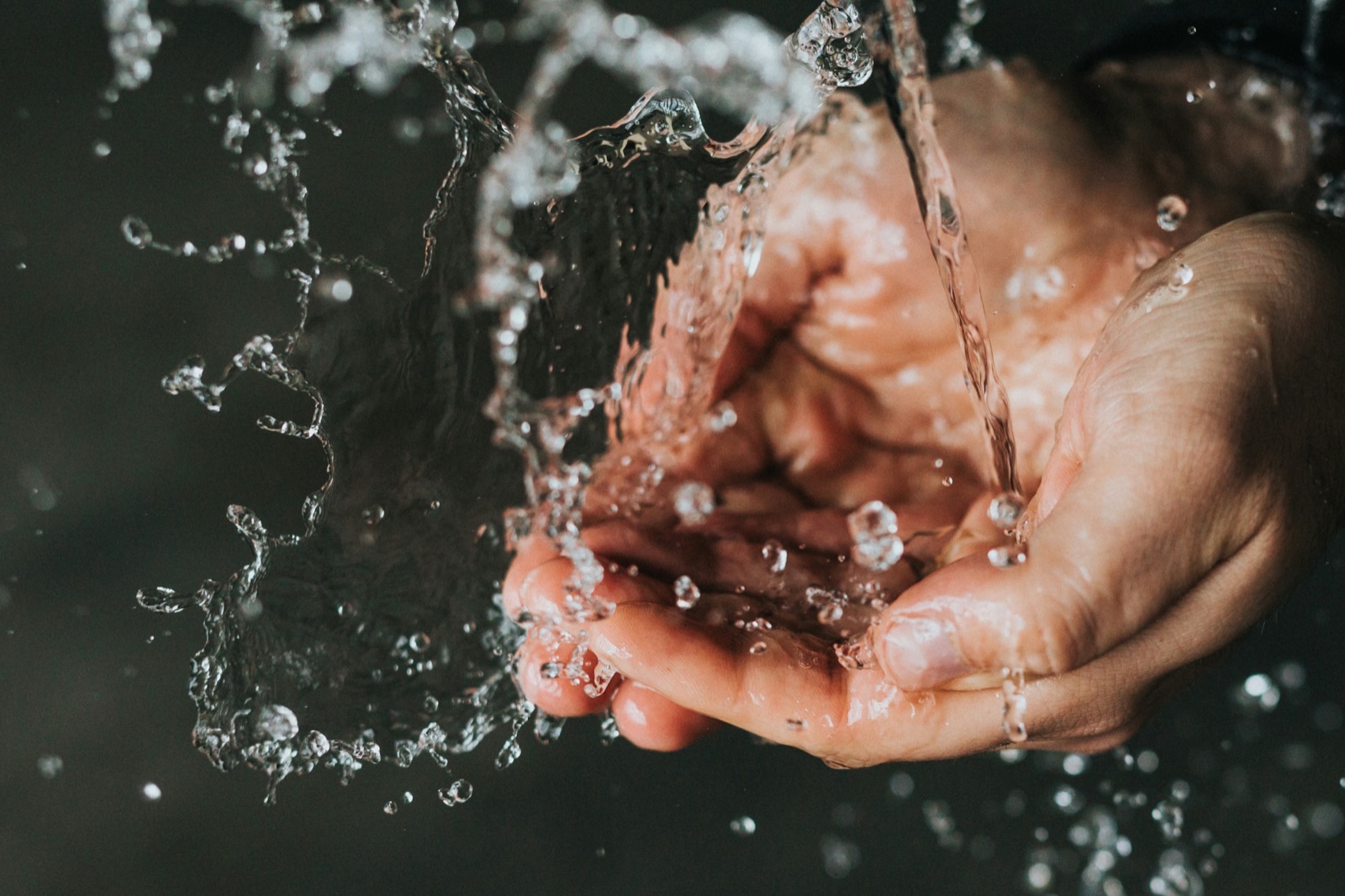
The sound of running water is a conditioning cue. Your brain has linked that sound to urination since childhood. The studies are small, but they point the same way. In men with urinary symptoms, playing running-water sound during a flow test lifted peak flow from 12.3 to 15.7 mL per second ([5]). During bladder X-ray exams, people who heard running water felt the urge sooner and emptied faster ([15]). The warm-water cousin, a hand resting in a basin of warm water, has folklore status rather than trial evidence. These are gentle nudges. They cost nothing. They work best when the bladder already has something in it. Turn on the bathroom sink and wait.
Breathe out slow and let your belly go soft
Take a slow breath in through the nose. Then a long, steady breath out through the mouth, and let your belly go completely loose, like you are loosening your waistband after a big meal. That soft belly tells the pelvic floor it is safe to let go. The people who write the flow-test standards treat this as ground truth: the ICS good-practice document notes that flow results are inherently sensitive to cooperation and emotion, and only count when the void was a relaxed, representative one ([6]). This is not a meditation exercise. One or two long exhales, belly soft, shoulders dropped.
Gentle tapping below the navel
Try light, rhythmic tapping on the lower belly, about two inches below the navel, for 20 to 30 seconds. This is a sensory nudge, not a medical technique. The formal version, called triggered reflex voiding, has its evidence base in people with certain spinal cord injuries, where stimulating the skin over the lower back and sacrum can set off a reflex bladder contraction ([3]). For someone whose bladder and nerves are working normally, gentle tapping is a low-risk "wake-up knock on the door." Never press hard on the bladder. If tapping does not start things within a minute, move on.
Drink a glass of water, then give it time
This is the slow-but-certain route. Drinking water works because it adds volume, and volume is what eventually triggers the urge. But it is not instant. In a classic study, only about 15% of a water load had become urine by 20 minutes, and roughly 35% by 60 minutes ([7]). How hydrated you are at the start matters: when your body is already well topped up, it clears the surplus in about 75 minutes, but when you start out dry, the same volume takes closer to 130 minutes because your kidneys hold more of it back ([14]). The takeaway: drink a glass, then give it 30 to 60 minutes. Do not chug a liter and expect magic.
Buy yourself privacy and a minute
If the problem is that someone is waiting outside the door, or you are in a public restroom with traffic, the fix is simpler than any technique. Pick a stall. Lock it. Stop watching the clock. Tell whoever is waiting you need a minute. Difficulty peeing in the presence of others is a real, common, named condition called paruresis. A UK survey found that roughly one in four people experience it to some degree, and that men carry two to three times the odds of struggling with it ([13]).
How fast does each trick work?
Nobody else answers this, so here is an honest estimate.
| Technique | Typical onset | Works only when... |
|---|---|---|
| Sensory cues (running tap, warm water) | Seconds to 2 minutes | The bladder already has volume. On an empty bladder, these do nothing. |
| Posture + breathing (sit, lean, exhale) | Immediate | There is urine pressing behind the gate. |
| Tapping below the navel | Within a minute, or not at all | Worth trying once, then move on. |
| Drinking water | 20 to 60 minutes | You have time to wait. About 35% of the fluid is excreted by one hour ([7]). |
The pattern is clear. The first three are "right now" tricks for a bladder that already has something in it. Drinking water is the "plan ahead" route.
The clinic scenarios, one by one
The right approach depends on why you need to pee right now.
Giving a urine sample
You are handed a cup. The expectation hangs in the air. Here is the plan: drink a glass of water when you arrive at the clinic, then ask to go last or ask to wait 20 to 30 minutes. When you do go, run the tap, place a hand under warm water, sit down, lean forward, and exhale slowly. A midstream sample means letting the first splash go into the toilet, then catching the middle of the stream in the cup. Nobody gets this perfect on the first try, and that is fine.
Before a uroflow (pee-on-a-machine) test
A uroflow test measures how fast and how completely you empty. It reads best when you pass at least about 150 mL, roughly two-thirds of a cup ([16]). The goal is to arrive comfortably full, not bursting. An overstretched bladder distorts the result: overdistended voids produce more abnormal flow curves, more leftover urine, and at the extreme the peak flow rate actually falls ([9]). The flow-test standards put it plainly: a result can read abnormal simply because you waited too long before the test ([6]).
So do not chug a liter in the waiting room. Drink normally in the hour before. When you sit on the machine, treat it like a normal bathroom visit: sit, lean, exhale, and do not strain. If nothing comes, tell the technician. The right move is to wait and rehydrate, not to force out a trickle. A result only counts when the void was representative of the real thing ([6]).
Filling up before an ultrasound
This is the opposite job. Here you want a full bladder because the fluid acts as an acoustic window for the ultrasound probe. Follow the clinic instructions (commonly about 500 mL to 1 liter of water, finished roughly an hour before the scan). The timing section above explains why: most of the water will not become bladder volume for 30 to 60 minutes ([7]). If you feel nothing at 30 minutes, do not panic and double the dose. The water is still working its way through.
When someone is waiting (public toilets, someone outside the door)
Privacy is the fix. Pick a stall. Lock it. Put your phone away and stop timing yourself. Run the tap if there is one. One long exhale, belly soft. Give yourself an unhurried minute. If this happens to you regularly in public restrooms or shared bathrooms, know that it is genuinely common: a UK survey found that about 26% of people reported mild difficulty and about 15% severe difficulty peeing in the presence of others ([13]). The odds for men were two to three times those for women.
What NOT to do
Key rule: Every "don't" on this list boils down to one principle. The bladder outlet opens when muscles relax. Anything that raises pressure, straining, pressing, or chugging fluid right before a test, works against that.
Never strain or bear down
This is the single biggest myth in the how-to-pee advice space. Straining feels like it should help. It does the opposite. When you bear down, the pressure spike triggers a reflex clench of the sphincter, the very muscle that needs to open. The result is more resistance, not less, and a bladder that empties worse ([3]). European urology guidelines are blunt: the high pressures straining creates are hazardous for the urinary tract, and the technique should be discouraged outside specialist supervision ([3]). Even in spinal-cord-injury care, where straining was once routine, catheter-based emptying is now the preferred method ([4]). Some popular health websites still recommend bearing down. They are out of step with the evidence.
Never press hard on your lower belly
Pushing on the lower abdomen to squeeze urine out is a supervised medical technique used in specific neurological conditions. It is not a bathroom trick. The pressure tends to make the outlet clamp down, so the bladder can end up emptying less completely, not more ([3]). The guidelines that govern its supervised use warn that the high pressures are hazardous for the urinary tract unless testing shows pressures stay within a safe range ([3]).
No panic-chugging before a flow test
Drinking a liter right before a uroflow muddies the very test you came for. Overfilled bladders produce more distorted flow curves and more leftover urine ([9]), and holding on too long before the test can itself make the result read abnormal ([6]). Your clinician then has to repeat the test anyway.
Caffeine and alcohol are not shortcuts
Both increase urine production, and caffeine in particular is tied to urgency. In controlled studies, cutting caffeine intake measurably calmed urgency symptoms ([18]). Using coffee or beer to force a void before a test introduces variables that muddy the results, and your clinician cannot read a flow curve through them. For more, see the bladder irritants guide.
Never try to catheterize yourself
A catheter is a sterile medical device inserted by a trained clinician. Do not attempt this at home.
When "I can't pee" is an emergency
Most of the time, struggling to get the stream going is an inconvenience, not a crisis. But two patterns need same-day care.
Acute retention. You suddenly cannot pass any urine at all, and your lower belly is full, swollen, and painful. This is a same-day emergency. The fix is direct: a clinician drains the bladder promptly with a thin, soft catheter ([10])([11]). Do not wait it out.
Nerve emergency. Sudden trouble peeing combined with numbness in the groin or inner thighs (the area a saddle would cover), new pain shooting down both legs, or new severe back pain. That combination can signal a condition called cauda equina syndrome. It is rare, and it is an emergency that needs same-day assessment ([12]).
For the everyday kind of difficulty, the kind that has been creeping up over weeks or months, the voiding symptoms hub maps the territory and two guides go deeper. If the stream is slow to start most days, see the trouble starting to pee guide. If it flows but flows weakly, see the weak urine stream guide.
Frequently asked questions
How can I make myself pee fast?
The fastest path is the combination: sit down, lean forward slightly, take one long breath out and let your belly go soft, and run the tap. This works in seconds to a couple of minutes when the bladder already has volume. Drinking water is the reliable route but takes 30 to 60 minutes to produce results ([7]).
How do you pee when you're nervous?
Privacy and time are worth more than any technique. Pick a stall, lock it, and stop watching the clock. One long exhale with a soft belly helps the pelvic floor relax. If this happens to you regularly, know that it is common: roughly one in four people experience some degree of difficulty peeing in the presence of others ([13]).
Why can't I pee even though I feel the urge?
Usually it means the pelvic floor is clenching instead of relaxing. Anxiety, cold, or someone waiting nearby can keep the gate shut even when the bladder is full. Sit, breathe out, give it time. If you regularly feel the urge but nothing comes, see the trouble starting to pee guide and consider talking to a pelvic-floor physical therapist.
How long can you go without peeing?
For most adults, the urge to go arrives roughly every three to four hours during the day, scaling with how much you drink ([17]). Holding occasionally while you find a bathroom is normal and nothing to fear. The real concern runs the other way: a bladder that cannot empty. If you feel full and painful and nothing will come out, that is the emergency described above.
How much water should I drink before an ultrasound?
Follow your clinic's instructions. A common guideline is about 500 mL to 1 liter, finished roughly an hour before the appointment. Do not double the dose if you do not feel urgency at 30 minutes. The water is still being processed. About 35% of it becomes urine within the first hour ([7]).
Does the running water trick actually work?
It does, modestly. In a small trial in men with urinary symptoms, the sound of running water improved peak flow ([5]), and people undergoing bladder X-ray exams who heard running water felt the urge to void sooner ([15]). It works best when the bladder already has volume in it. On an empty bladder, it will not conjure urine from nowhere.
Can you make yourself pee instantly?
Not truly. The fastest realistic path is seconds to a couple of minutes with sensory cues and relaxation, and only when the bladder already has urine in it. There is no instant override button. Try the techniques above and give yourself a calm minute.
Marcus drank a small glass of water when he first sat down. He ran the tap. He sat, leaned forward, took one slow breath out, and let his belly go soft. Thirty seconds later, the stream started. It was not dramatic. It was not instant. It was enough.
This article is for general education and is not a substitute for medical advice from your healthcare provider. If you are experiencing symptoms that worry you, contact a clinician. Photo: Nathan Dumlao on Unsplash.